NTOU Collaborates with Palau to Tackle Climate Change
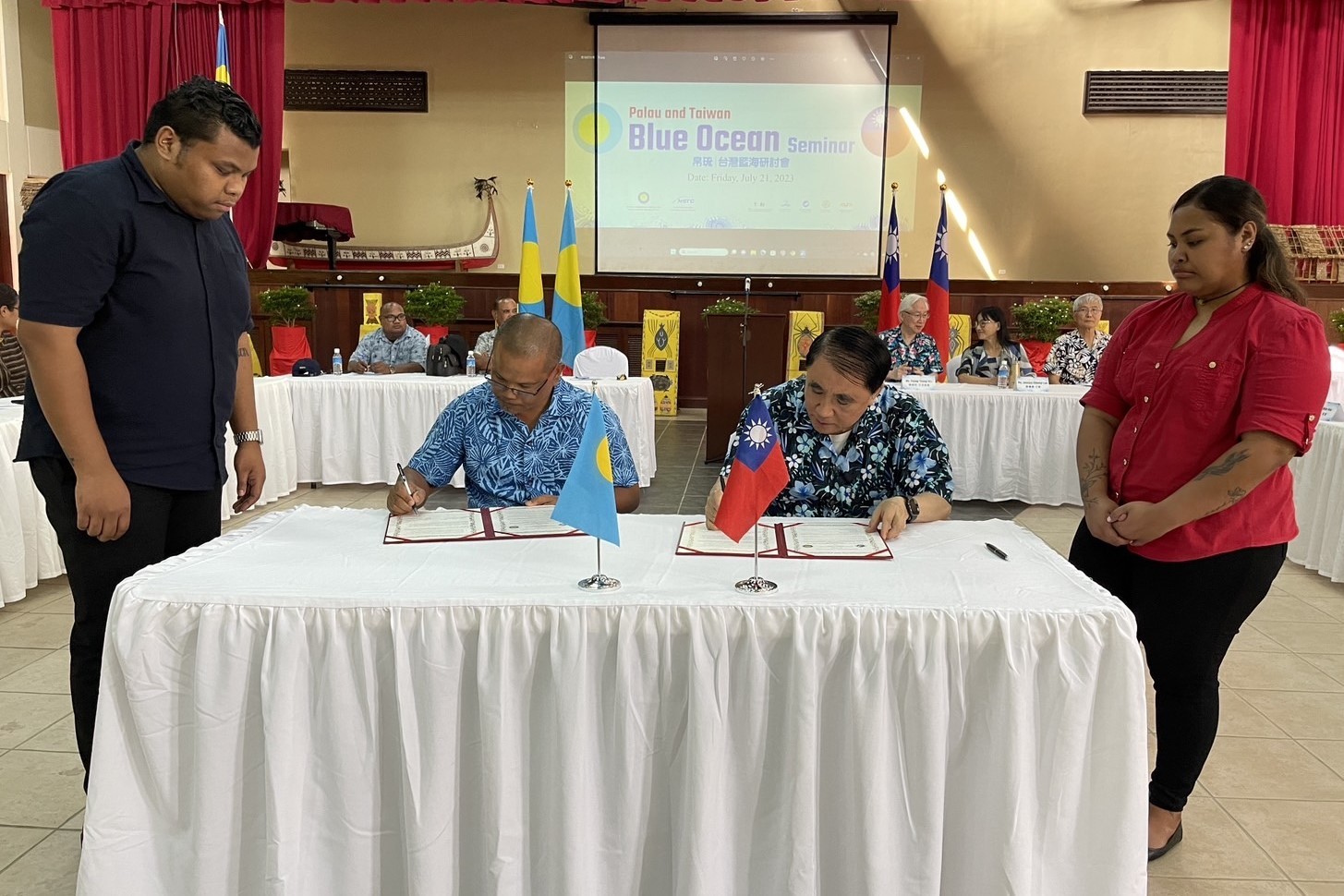
In response to the challenges posed by global climate change, on July 21, the National Taiwan Ocean University (NTOU) and the Ministry of Agriculture, Fisheries, and Environment of the Republic of Palau signed a Memorandum of Understanding (MOU) to strengthen their collaboration. The signing ceremony took place under the witness of Wu Tsung-Tsong, Chairperson of the National Science Council, with NTOU President Hsu Tai-Wen and Palau's Minister of Agriculture, Fisheries, and Environment, Steven Victor, representing their respective institutions.
President Hsu Tai-Wen expressed that NTOU has achieved significant research accomplishments in aquaculture technology and marine resource investigation, with many of their technologies leading globally. The university has maintained a longstanding and close partnership with Palau in related fields. He also extended his gratitude to Minister Steven Victor for visiting NTOU and the Aquatic Animal Experiment Center last year, along with Palau's Minister of State, Gustav N. Aitaro. Through the signing of the MOU, both parties aim to enhance marine science and technology research and promote sustainable development of marine resources. NTOU also warmly welcomes Palauan students to pursue studies at their university.
The signed MOU will focus on three major areas of collaboration: upgrading and providing guidance on aquaculture technology, developing marine and renewable energy technologies, and addressing environmental issues caused by climate change. The objectives are to improve the efficiency and sustainability of aquaculture, accelerate the development of green energy technologies like tidal, wind, and solar power, and work together to tackle challenges related to climate change and rising sea levels, by formulating various protective measures.
Professor Chiang Kuo-Ping, who is also the convener of Taiwan Ocean Union, supplemented that global environmental changes have already altered the oceans and climate. The research team has collected scientific samples from Palau's tropical waters to better understand how the region can cope with rising temperatures and increasing carbon dioxide concentrations in the future. The results obtained through marine science sampling can also be used to refine and establish models for carbon circulation in waters surrounding Taiwan and the open seas. In the future, both parties can strengthen their collaboration on blue carbon issues, collectively confronting one of the world's most significant environmental and ecological challenges.
For more information on marine science content, please visit Taiwan Ocean Union's website at: https://tou.ntou.edu.tw/